Click-through rate is one of the most misunderstood metrics in digital advertising. People often treat it as nothing more than a tally of how many visitors an ad sends to a page. In reality, CTR is the clearest early signal of which ads actually catch your audience's eye and which just slide past in their feed.
That role matters even more depending on your campaign goal: getting audiences to know your product better, or driving conversions by pushing them to buy right away. So in this article, we'll cover why click rates end up low, what that does to your budget, how to calculate CTR, and how to raise it for your digital marketing campaigns.
Why Your Ads Are Getting a Low Click-Through Rate
If your CTR is stuck at a low number, the root problem usually isn't just how the ad looks. It's a campaign setup that's off. Even a well-made ad struggles to earn clicks when it's shown to the wrong people, at the wrong time, or with the wrong message.
According to Joe Domaleski in Marketing Data Science, low impressions caused by limited ad visibility are a roadblock to a strong CTR. On the other hand, strategic missteps such as poor audience targeting, mismatched messaging, or choosing the wrong channel can undermine your ads' ability to win over an audience.
How a Low Click-Through Rate Hits Your Ad Budget
Ad platforms read CTR as a sign of whether your ad is relevant. When your click rate is low, your quality score drops with it, and you lose ground to competitors. The longer an ad runs with a sluggish click rate, the lower its quality score sinks in the eyes of platforms like Google or Meta, and the more you pay for every click.
So you end up paying extra just to stay competitive, and in the end you're throwing even more money at reach that isn't paying off. The tricky part is that these warning signs rarely stand out in daily reports. Clicks keep coming in, the budget keeps running, and everything looks normal until the monthly report shows your cost per click has already ballooned.
The CTR Formula and How Marketing Teams Calculate It
Technically, CTR comes from a simple formula:
- Clicks ÷ impressions × 100%
The more clicks you get from the same number of impressions, the higher your CTR. For example, if your ad is shown 10,000 times and earns 300 clicks, your CTR is 3%. That number is then compared against benchmarks to judge whether performance is healthy or needs serious work.
In practice, marketing analysts rarely read CTR on its own. These companion metrics are usually tracked alongside it for a fuller picture of ad performance:
- Impressions: how many times your ad appears on your audience's screen, and the denominator in the CTR formula.
- Cost per Click (CPC): the average cost each time your ad is clicked, which usually moves in the opposite direction from CTR.
- Cost per Mille (CPM): the cost per 1,000 impressions, used to compare reach efficiency across campaigns.
- Expected CTR: Google's prediction of how likely your ad is to get clicked compared with competitors on the same keyword, and one of the components of Quality Score.
These metrics keep marketing teams from staring at a single number in isolation. They also help flag problems with reach, budget, and ad relevance.
What Counts as a Healthy Click-Through Rate in Digital Advertising?
According to a Brandwatch report citing 2025 WordStream research, the average CTR for Google Search Ads is 6.64%. That's far higher than Google Display Ads, which average just 0.57%.
Average CTRs on social platforms such as Facebook Ads (Feed) and Instagram Ads are also much lower than on Google Search Ads, at roughly 0.80% to 1.49%. The gap exists because people typing a keyword into a search engine are already looking for a solution, not just scrolling idly the way they do around display ads.
Every industry also has its own benchmark for average CTR. But those averages won't necessarily reflect your business, because what counts as a good CTR varies from industry to industry.
Here are 2026 CTR benchmarks for Google Search (Search Network) by industry, according to WebFX research:
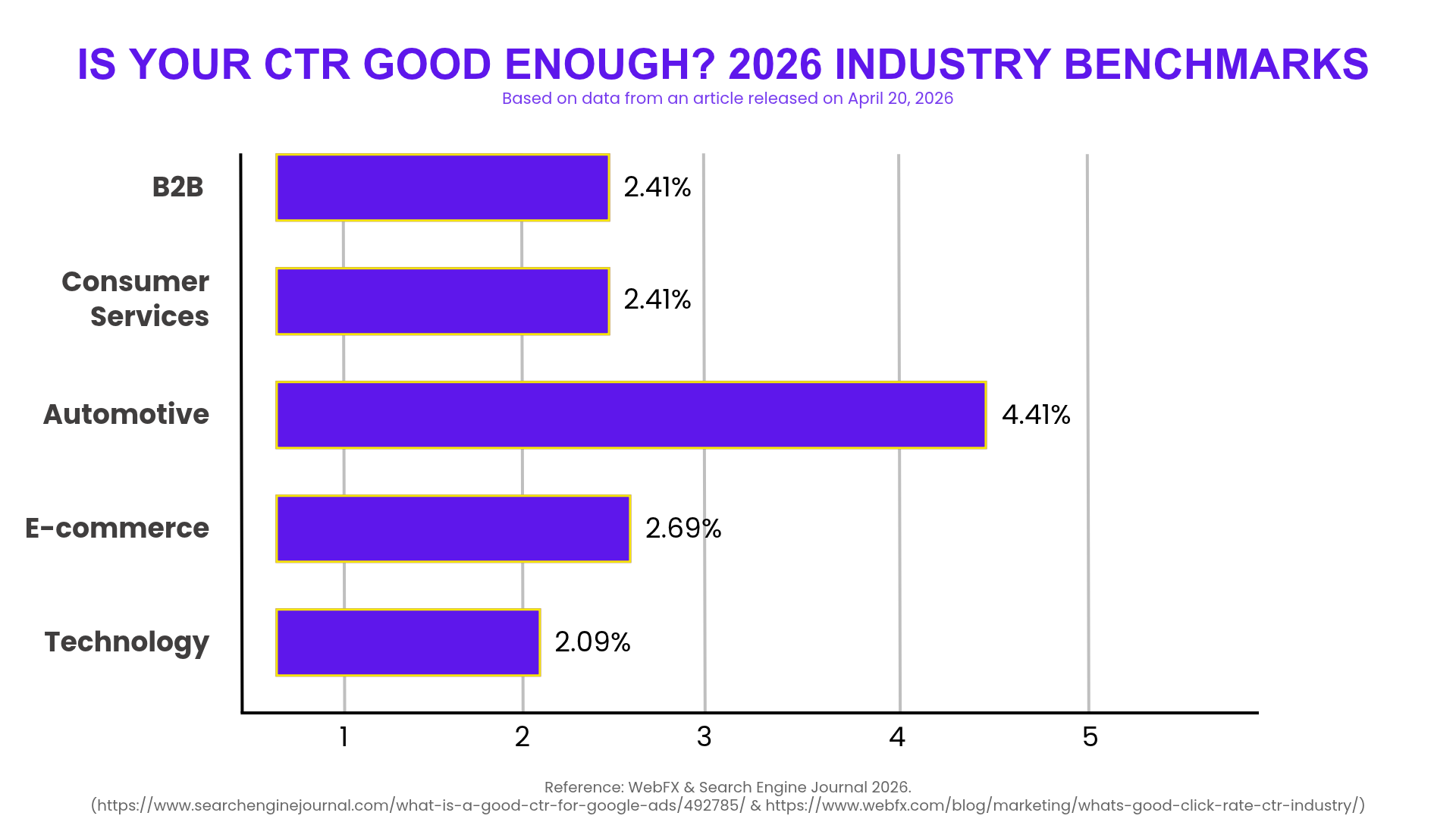
Example infographic: CTR benchmarks by industry | Source: https://www.webfx.com/blog/marketing/whats-good-click-rate-ctr-industry/
For businesses in Indonesia, click rates like these can serve as a starting reference before you tailor targets to each industry and platform. For example, a brand advertising on Google Search with a click rate below 3% typically pays more per click than a competitor whose ad copy better matches what the audience is searching for. A small gap like that, left unchecked, can quietly eat away at your monthly marketing budget.
How a Healthy Click Rate Makes or Breaks a Brand's Digital Ad Campaigns
A healthy click rate is more than good-looking numbers in a marketing report. It's the first signal of how relevant your ads are. According to OuterBox, a healthy CTR indirectly lifts your ad quality score, too. In effect, Google reads it as a sign that you care about quality and want to give your brand's audience the best possible ad experience.
Once your CTR looks good, you can steer the rest of your budget toward people who are genuinely interested, instead of spreading it across everyone at random. From there, your ad dollars go further, since a healthier click rate makes every campaign more efficient.
A healthy CTR also works as an early indicator, so your team can tell which creatives are likely to succeed within just the first few days. That's what makes a healthy click rate the key dividing line between efficient campaigns and campaigns that burn through budget with no clear indicators.
How to Raise Your Click-Through Rate in Digital Marketing Campaigns
There are several ways to push your click-through rate up and get more out of your digital campaigns. Here are five tips for fixing a stagnant CTR, drawn from Equinet Academy and Bloomreach:
1. Use Eye-Catching, Relevant Visuals
Compelling visuals are one of the most effective ways to grab your audience's attention, because people process images far faster than text. Ads that include images, video, or infographics tend to be more memorable and can earn more clicks.
Make sure the message in your visuals is truly relevant to the audience you're targeting, not a generic stock photo slapped on just to stand out.
2. Use A/B Testing on Your Ad Messaging
A/B testing is standard practice in just about every field, but it matters most in paid advertising. Try varying your ad formats to see which types of content and combinations genuinely work. Then use the results to keep refining your campaigns over time.
3. Write CTAs That Offer the Audience a Benefit
CTAs like "Click Here" or "Visit Page" simply tell your audience to do something without giving them a reason why. A benefit-driven CTA answers the question at the front of their mind, "What's in it for me?", by showing what they'll get after clicking.
This approach can lift conversions because it reduces hesitation, and it works even better when matched to where your audience sits in the funnel: just discovering your brand, or ready to buy.
4. Monitor and Adjust Based on Performance Data
Keep monitoring regularly to hold your CTR steady, since audience behavior and platform algorithms are always shifting. Set up automated reports to track performance so you can spot new trends right away and adjust your strategy at the first sign of a dip.
Let data and insights, not assumptions or gut feeling, drive your planning and optimization.
5. Make Sure Your Ads Work Well on Mobile
Google reports that 61% of mobile users are unlikely to return to a site that gave them trouble, such as glitches, slow loading, and bugs. This matters even more when your campaign draws lots of visitors from other platforms, especially social media, which is so easy to reach from a phone these days.
So make your business pages easier to use on smaller screens, because mobile-friendliness plays a crucial part in boosting CTR performance.
What a Higher CTR Does for Your Costs and Your Campaign's Reputation
A healthy click-through rate directly lowers your cost per click, because ad platforms see your ad as relevant to the audience. That higher quality score ultimately makes your ad budget work harder without adding a cent to it.
Beyond cost, a consistently high click rate also signals that your brand's message truly resonates with your target market. Research from Rajamangala University in Thailand found that a higher CTR suggests most of the audience finds the ad intriguing enough to spark their curiosity. By extension, it indicates that the ad appeals to most of the people who see it.
Teams can also use this data to plan their next content strategy and campaigns with more confidence. For example, a fashion business that routinely tracks click rate by keyword can see which products are in highest demand before stock runs out. From there, the marketing team can shift ad budget toward the products the market actually wants.
Don't Let Your Ad Budget Leak
Click-through rate is more than a statistic for measuring your business ads. It's an early-warning signal, well before a monthly report shows your marketing costs have ballooned.
From the basic formula and platform benchmarks to ways to raise it, through strong visuals, A/B testing, the right CTAs, and mobile optimization, it all points to one thing: a healthy click rate is the earliest signal of how efficient and effective your marketing budget really is.
If you're tired of struggling to explain why spend keeps climbing while conversions stay flat, it's time to stop guessing in your ad planning.
Together with Floothink Digital, we will ensure every piece of your ad budget work for you, not leak away unnoticed.
Reference:
Bohan, Donna M. (April 20, 2026). 7 Proven Ways to Improve Your Click-Through Rate (CTR) in 2025. bloomreach. Accessed on October 1, 2026:
https://www.equinetacademy.com/blog/10-powerful-tips-to-improve-your-clickthrough-rate-fast/
Brandwatch Survey Team. (March 11, 2026). What is Click-Through Rate (CTR). Brandwatch. Accessed on September 25, 2026:
https://www.brandwatch.com/social-media-glossary/click-through-rate/
Jeremiah, Lim. (August 26, 2025). 10 Powerful Tips to Improve Your Click-Through Rate Fast. Equinet Academy. Accessed on October 1, 2026:
https://www.equinetacademy.com/blog/10-powerful-tips-to-improve-your-clickthrough-rate-fast/
Sypen, B. (April 14, 2026). How to Increase Your Click-Through Rate (CTR). Outerbox. Accessed on September 25, 2026:
https://www.outerboxdesign.com/articles/seo/how-to-boost-ctr/
Image:
https://www.magnific.com/free-photo/man-typing-laptop-with-bokeh_6278878.htm#fromView=search&page=1&position=3&uuid=b9fd314d-7663-4427-b27a-181ba4bd40c2&track=ais_hybrid&query=click+through+rate